You hear the indoor fan, air is coming out of the vents, but it's room temperature and the unit outside is quiet. It's one of the most common calls we take in Pinellas Park, especially in the heat of summer. The good news: the cause is often a single, affordable part. The important part is what you do while you wait.
Why is my outside AC unit not running when the inside is?
Your central AC has two halves. The indoor air handler holds the blower fan and the cold evaporator coil. The outdoor condenser holds the compressor, which pumps refrigerant, and the fan that sheds heat outside. The thermostat sends a low-voltage signal to both. If the indoor half gets its signal and power but the outdoor half doesn't start, you get air movement with no cooling.
| What you notice outside |
Likely cause |
| Completely silent |
Tripped outdoor breaker, pulled disconnect, no 24V signal, failed contactor, or a safety switch (float or pressure) has opened |
| Humming, but the fan doesn't spin |
Failed capacitor, seized fan motor, or a compressor struggling to start |
| Clicking on and off |
Contactor chattering, low control voltage, or a safety switch cycling |
| Fan runs but air inside stays warm |
Compressor not starting, often a capacitor, or low refrigerant |
Symptom-to-cause guide for an AC outdoor unit not turning on. A technician confirms the cause with a meter.
What safe checks can I do first?
These checks are safe and don't involve opening any panel:
- Turn the thermostat to Off for five minutes, then back to Cool. Many systems have a short delay to protect the compressor.
- Check the breaker once. Find the outdoor unit's breaker in your main panel (it's usually a double breaker). If it has tripped, turn it fully off, then on. If it trips again, leave it off and call us.
- Check the outdoor disconnect. The small box on the wall by the condenser should be fully On, with any pull-out block seated firmly.
- Clear debris around the unit: leaves, grass clippings, vines or anything blocking the top fan or the sides.
- Look at the drain. Some float switches cut the signal to the outdoor unit while letting the indoor fan run. If the drain pan is full, that may be your cause.
Don't remove the condenser's service panel, poke at the fan, or try to spin it with a stick. The parts inside carry high voltage and capacitors can hold a charge.
What does it mean if the outside unit hums or clicks?
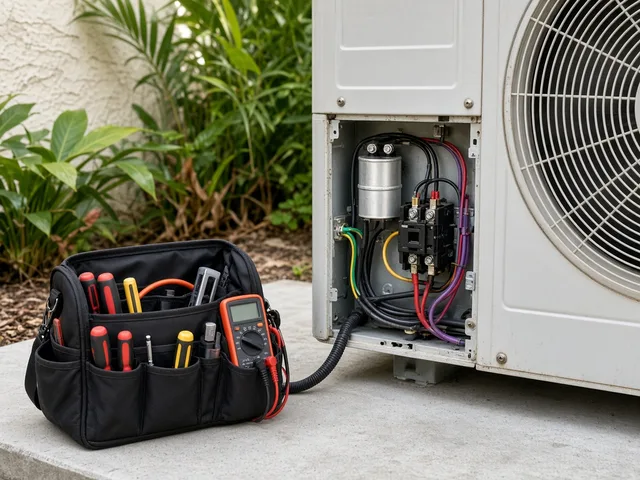
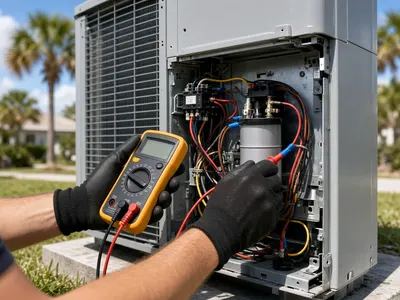
A hum with no fan movement usually means the motors are getting power but can't start. The most common culprit is the run capacitor, a small cylinder that gives the compressor and fan motor a kick to get going. Florida heat is hard on capacitors, and a weak one is one of the most frequent summer repairs.
Clicking usually points to the contactor, the relay that switches power to the outdoor unit when the thermostat calls. A pitted or stuck contactor can chatter, stay open, or even stay closed. Both parts are quick for a technician to test and replace. Leaving a humming unit on can overheat the compressor, so turn the system off at the thermostat.
AC not cooling right now? Call (727) 761-8873 (answered 24/7) or get a free quote.
Why did my outside unit stop after a power outage or storm?
If your outside AC unit is not running after a power outage, give it a few minutes first: many units wait before restarting. If it still won't start, check the breaker and disconnect. Storms can trip breakers, and voltage spikes from lightning or power coming back can damage a capacitor, contactor or control board. A surge-damaged part is a common cause after a summer storm.
Why should I turn the AC off while I wait?
Running the indoor fan with the outdoor unit off doesn't cool your home, and in some cases it can cause harm. If the compressor is partly working or refrigerant is moving without the outdoor fan, pressures can climb and the compressor can overheat. In other cases the indoor coil can get cold enough to ice up, and when that ice melts it can overflow the drain pan. Turning the thermostat to Off protects the equipment until it's checked. Switching the fan to On can help circulate air in the meantime, but it won't cool.
What does the fix usually cost?
Most outdoor-unit failures are one of these parts. Prices below are published market figures from one local contractor's job records, shown as estimates, not our quotes:
| Repair |
Typical cost (market estimate) |
| Capacitor replacement |
$279–$546 |
| Contactor replacement |
$294–$860 |
| Condenser fan motor replacement |
$749–$949 |
| Drain line clearing (float switch trip) |
$269–$558 |
Source: Home Therapist, HVAC cost report (middle half of jobs).
A compressor failure is far more expensive and is often the point where replacement makes more sense. Our diagnostic fee is $125, and it's credited toward the repair if you go ahead. We explain the price before work starts. If you're weighing a new system, see our guide to new AC unit cost by size in Pinellas Park.
When is it an emergency?
Treat it as urgent if anyone in the home is at risk from heat, such as elderly relatives, infants, someone with a health condition, or pets, or if you smell burning, see smoke, or the breaker keeps tripping. Our phone line is answered 24/7 at (727) 761-8873. After-hours rates are explained before any work starts. Until help arrives, keep the AC off, close blinds on sunny windows and use fans.
Why Pinellas Park homeowners call Pinellas Cooling & Heating
- 24/7 phone service at (727) 761-8873.
- 10 years repairing AC systems in Pinellas Park.
- $125 diagnostic credited toward the repair if you go ahead, and free estimates if a new system is the better choice.
- All major brands of central AC, heat pumps and ductless mini splits.
- Licensed and insured, and a Duke Energy verified contractor.
- GoodLeap financing on approved credit for bigger repairs or replacement.
Call us for AC repair in Pinellas Park. If the whole system is dead, start with our checklist for an AC that won't turn on.
Sources: Home Therapist, HVAC & Plumbing Cost Report (callhometherapist.com); U.S. Department of Energy, central air conditioning guidance (energy.gov). Prices are market estimates, not quotes.